Floof - My Pet House
- 4.1
- Rating
- 10.00M
- Installs
- Free
- Price

 Analysis by App-foxy
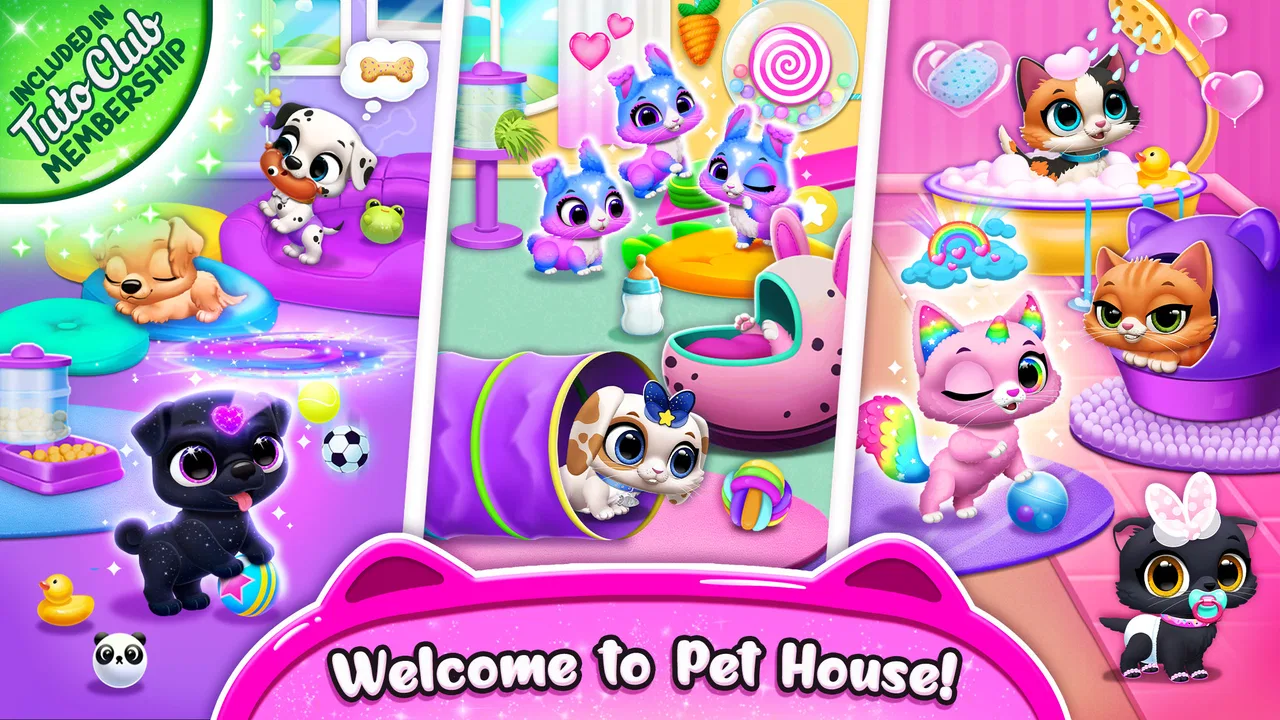
I spent time with Floof - My Pet House as a light, child-friendly pet game, and my first impression was clear: it is built around the comfort of looking after cute virtual animals rather than around difficult goals or complicated strategy. You adopt a dog, cat, and rabbit, then use the home environment as a playful space for caring, decorating, and spending time with them. That makes it easy to understand within minutes, even for a young player who has never opened a simulation game before.
The game comes from TutoTOONS and sits in the educational category, although I would describe its learning value carefully. It is not a lesson-based app with formal reading, mathematics, or science exercises. Instead, it encourages gentle routines, observation, choice-making, and responsibility through pretend pet care. For families looking for a relaxed activity with an animal theme, that distinction matters. I found it more suitable as an interactive playroom than as a replacement for a dedicated learning app.
How Floof feels to use today
The current package is free to start, carries an Everyone content rating, and supports devices running Android 6.0 or later. That broad compatibility helps explain why it is easy to consider for an older family phone or tablet. It has also reached over 10 million installs, with an average rating of 4.1 from around 46 thousand ratings. Those figures suggest a well-known children’s title with a substantial audience, but they do not remove the need for parents to look at how the game fits their own child’s habits.
You May Also Like

 Blood Strike: 2.5 Anniversary
Blood Strike’s Loadouts Turn Every Drop Into a Tactical Gamble
A close look at Blood Strike’s custom loadouts: how fast access to signature weapons reshapes its battle royale rhythm, rewards preparation, and narrows the gap between fights.

 Pandora - Music & Podcasts
Pandora’s Music Is Easy to Start, but Harder to Recover
Pandora’s strength is its low-effort path from a seed to a station. Its weak spot is how much confidence it asks you to place in connection, setup, and quiet recovery.

 8 Ball Pool
 Is Built on Rivalries, Rematches, and Routine
A close look at the rivalries, rematches, shared routines, and unanswered safety questions that turn a quick pool match into a persistent mobile community.

 Samsung Music
’s Quiet Strength Is Playing What You Already Own
Its reach comes less from spectacle than from dependable access to a personal library. That simplicity is both the app’s strongest retention engine and its ceiling.

 AccuWeather: Weather Radar
AccuWeather Review: A Quick, Clear Forecast for Everyday Decisions
For everyday plans, the best forecast is the one you can understand quickly. AccuWeather makes rain timing, radar, and local conditions easy to act on, with a few trade-offs.

 Hill Climb Racing
Why Hill Climb Racing Still Turns Crashes Into One More Run
A tiny car, a bumpy hill and one more upgrade: Hill Climb Racing keeps resurfacing because its simple chaos makes every near-miss feel personal.
More From Our News Desk



My favorite part is the low-pressure structure. The animals are the reason to return, but the game does not feel like it is demanding expert timing or a long uninterrupted session. A child can open it for a short visit, interact with the pets, and leave without needing to remember a complicated story. That makes it useful during a quiet afternoon, while waiting at an appointment, or as a brief activity before another part of the day.
The dog, cat, and rabbit give the experience enough variety to make choosing feel personal. A child who prefers dogs may spend most of the time with that animal, while another player may enjoy switching between the three. I liked that the central appeal is not tied to one fixed character. The choice of pet becomes part of the play, and it gives siblings or friends an easy way to discuss what they would do differently.
There is also a strong imaginative element in the idea of creating a pet world. Children can treat the home as a small stage for pretend play rather than simply moving from one menu to another. In my experience, that is where the game works best: not as a challenge to complete as quickly as possible, but as a place where a child invents a routine for the animals and returns to continue it.
What a normal play session looks like
A realistic use case would be a child coming home from school and wanting something calming before homework. I would let them choose one animal, spend a few minutes caring for it, and then decide whether to visit the other pets. Because the interaction is familiar and visually inviting, the child can play independently without needing a long explanation from an adult. I would still check the device beforehand, especially if the child can reach purchase controls.
Another practical use is shared play between an adult and a younger child. Instead of handing over the phone and walking away, a parent can ask questions such as which pet looks happiest, what kind of home the animals should have, or why the child chose a particular item. That turns the game’s simple interactions into conversation. The app itself does not need to provide formal teaching material for this to become a useful moment of language practice and decision-making.
I also see value for children who like animals but are not ready for the work involved in caring for a real one. A virtual pet cannot teach every part of real pet ownership, of course, but it offers a safe way to explore the idea of feeding, playing, choosing, and maintaining a living space in pretend form. I would present it honestly as preparation for conversation, not as proof that a child is ready for an actual dog, cat, or rabbit.
Where the educational label fits and where it does not
Calling this an educational game makes sense if the category is understood broadly. The player practices simple sequencing: notice the pet, decide what it needs, interact, and return later. There is also a small amount of emotional learning in recognizing that different animals can invite different kinds of attention. These are soft skills, and they emerge through play rather than through explicit instruction.
Parents should not choose it when their main goal is structured academic progress. If a child needs phonics, arithmetic practice, spelling support, or a clearly measured curriculum, a specialist learning app will be a better fit. Floof can sit alongside those tools as a break or reward, but I would not use its educational category as a reason to replace them.
The game is strongest with children who enjoy pretend play and visual customization. It may be less appealing to a child who needs constant competition, fast action, or a clear level system. Likewise, older children may find the basic pet-care loop too gentle unless they already enjoy virtual companions. The Everyone rating tells me the content is broadly accessible, but age suitability is still personal: a game can be safe for all ages and still feel too simple for a particular child.
What has changed and what the current version means
The current version is 15.1.107, and the game was released on October 7, 2021. That history matters because this is not a brand-new experiment. It has had time to become an established product, and the version number shows that the developer has continued moving the app forward rather than leaving the original release untouched. I would view that as a positive sign for existing users who care about ongoing maintenance.
At the same time, a version number alone does not tell me that every update changes the way children play. Some releases can refine stability, presentation, or compatibility without creating a visibly different pet-care experience. I would therefore keep expectations realistic: the current build is the one to judge, while older players may notice a smoother or more polished experience without seeing the entire game transformed.
For someone returning after a long break, I would approach it as a familiar toy that may have received incremental improvements, not as a completely new sequel. The core promise remains the same: virtual dogs, cats, and rabbits in a personal pet setting. That consistency is helpful for children who dislike sudden changes, but it may disappoint players hoping for a deep redesign or a much more complex simulation.
The update history also affects how I would introduce the game to a child. I would first spend a short session checking the current controls, available areas, and purchase prompts myself. Children often learn interfaces quickly, but adults should know which parts are freely available and which interactions may lead toward optional spending. This small inspection is more useful than assuming that a familiar title works exactly as remembered.
How existing players are likely to experience the evolution
For a child already attached to the pets, continued version updates can make the app feel dependable. The important benefit is not necessarily a dramatic new feature; it is the ability to return to a familiar world on a supported device. A parent upgrading or reusing a phone may appreciate that the game still targets an accessible operating-system version rather than requiring a very recent handset.
There is a trade-off, though. A long-running free game can accumulate more places where the child is encouraged to explore optional content. That is not automatically a problem, but it changes the adult’s role. I would treat the game as a supervised free-to-play title, especially for younger users, rather than as a completely hands-off toy.
The purchase range is wide, from $1.49 to $159.99 per item. I would not let a child browse alone if the device has a saved payment method. The free entry point is useful for testing whether the pets and activities suit the family, but the presence of expensive individual items means the purchasing environment deserves attention. A parent who wants a strictly fixed-cost experience may prefer a paid app with no optional purchases instead.
Existing users should also remember that enjoyment can depend on repetition. A child may be fascinated during the first few visits and later ask for new ways to interact. That is normal for this type of game. Its appeal comes from returning to familiar animals, not from an endless stream of increasingly difficult objectives. If the child needs constant novelty, the app may work better as one choice in a small rotation than as the only game on the device.
Small strategies that make the game work better
One useful approach is to give each pet a different role in the child’s routine. For example, the dog can be the first stop after school, the cat can be visited before dinner, and the rabbit can be part of a quiet bedtime check. This is not a formal feature I would claim the game enforces; it is a simple way to turn open-ended play into a manageable habit without making it feel like homework.
I would also encourage children to explain their choices aloud. Asking “Why did you choose that for the rabbit?” or “What should we do before we leave?” transforms tapping into sequencing and expressive language. This works particularly well with younger children who enjoy naming objects and characters. The adult does not need to control the session; a few thoughtful questions are enough to add depth.
A third tip is to use short, defined sessions rather than leaving the game open indefinitely. The pet-house format can make a child want to keep checking for another interaction, even when the activity has become repetitive. A simple timer or a clear stopping point helps preserve the game’s cozy quality. I found that it is easier to end play positively when the child has a small plan, such as visiting each animal once and then putting the device away.
Finally, I would compare the game with real-life animal care only in a limited way. Letting a child help refill a water bowl or tidy a safe area at home can connect the virtual routine to reality, but the adult should explain that real pets need daily care, patience, money, and attention that a game cannot represent fully. That honest boundary keeps the app useful without giving it responsibilities it was never designed to teach.
Where it still falls short
The biggest limitation for me is depth. The game offers an approachable pet world, but players looking for a detailed simulation may find the routine too shallow. There is a difference between choosing activities for a cute virtual animal and managing the complex needs of a simulated pet over a long period. Floof leans firmly toward accessibility and charm, which is a good decision for its audience, but it narrows its appeal for experienced simulation players.
The free-to-play structure is the other important friction point. Free installation makes it easy to try, yet the optional items can complicate the experience for families trying to avoid purchase pressure. I would set device-level purchase protections and explain to the child that not every visible item is necessary. If the goal is a completely distraction-free educational session, a focused offline learning app may be a better choice.
I would also skip it for a child who becomes upset when a game presents attractive locked content. Even when the basic experience is enjoyable, the awareness of things that can be bought may change the mood of play. This is not a criticism unique to this title, but it is especially relevant when the audience includes young children who may not understand digital prices.
Compared with a traditional puzzle or early-learning app, Floof gives up measurable practice in exchange for imagination. Compared with a larger life-simulation game, it offers a gentler and more accessible setting but less complexity. Compared with a real pet, it is convenient, clean, and consequence-free, but it cannot provide the sensory, emotional, or practical responsibility of caring for an animal. I would choose it when those trade-offs are advantages, not when I want a complete substitute for another option.
What I would watch before recommending it widely
I would pay attention to how future versions preserve the simple controls while keeping the experience fresh. The best evolution would add meaningful variety without turning the pet house into a crowded or demanding system. For young players, clarity matters more than a large number of features. New content should make the animals feel more expressive and the home more personal, not simply add more things to purchase.
I would also watch how the game balances its free starting point with optional spending. Families need to know that the basic experience remains comfortable without buying every attractive item. Since individual purchases can range from a small amount to $159.99, transparency and strong parental controls are especially important. I would make that check part of setup rather than waiting until a child asks for something.
Device support is another practical point. The minimum requirement of Android 6.0 makes the game reachable on older hardware, but performance can still vary between phones and tablets. I would test it briefly on the intended device before promising it as a travel activity. A child’s enjoyment depends on responsive controls and a stable session, particularly when the game is being used to fill a short waiting period.
Most importantly, I would watch whether a child keeps inventing reasons to return to the animals. That is the clearest personal measure of value here. If the pets encourage conversation, gentle routines, and creative play, the app is doing its job. If the child only chases locked items or loses interest after a few minutes, another game may be a better match.
My overall view is positive, with sensible limits. TutoTOONS has made a welcoming animal game that is easy to understand, suitable for a broad age range, and flexible enough for short family-friendly sessions. I recommend it to younger children who enjoy caring for virtual pets and to parents who are comfortable supervising a free game with optional purchases. I would skip it for serious academic practice, deep simulation, or a completely purchase-free environment. Used as a gentle digital pet house rather than as a full learning curriculum, it is a pleasant choice that earns its place in a child’s game rotation.
FAQs for Floof - My Pet House
01What is the main objective of Floof - My Pet House?
Floof - My Pet House allows players to adopt and care for a variety of virtual pets in a fun and interactive environment. The main objective is to nurture your pets by feeding, grooming, and playing with them, while also decorating their living spaces. This game combines pet care with creative home design, appealing to both animal lovers and creative minds.
02Is Floof - My Pet House suitable for children?
Yes, Floof - My Pet House is designed to be family-friendly and is suitable for children. The game features simple controls and colorful graphics that are perfect for younger players. It also encourages responsibility through pet care tasks, making it an engaging and educational experience for kids.
03Are there in-app purchases in Floof - My Pet House?
Floof - My Pet House does offer in-app purchases that allow players to buy premium items and unlock additional content. While the game is free to download and play, these purchases can enhance the gaming experience by providing exclusive items and faster progression. It's advisable to monitor in-app spending, especially if children are playing.
04Can Floof - My Pet House be played offline?
Floof - My Pet House requires an internet connection to access certain features and updates. While some basic gameplay elements might be accessible offline, a stable connection ensures the best experience, including accessing new content, participating in events, and synchronizing progress across devices.
05How customizable are the pets and environments in Floof - My Pet House?
The game offers a high level of customization for both pets and their environments. Players can choose from a wide range of pet breeds, outfits, and accessories, as well as various furniture and decor items for their pet houses. This extensive customization allows players to express their creativity and personalize their gaming experience.
Pros
- Engaging and colorful graphics.
- Wide variety of mini-games.
- Customizable pet features.
- User-friendly interface.
- Regular updates and new content.
Cons
- In-app purchases can be pricey.
- Occasional ads disrupt gameplay.
- Requires a stable internet connection.
- Limited offline features.
- May drain battery quickly.

Floof - My Pet House
Gallery